Roles and API tokens
Every person in an organization has a role, and every token acts for a person with no more rights than that role. Agents and CI use tokens; they never take a seat.
Roles
| Role | May do | Seat |
|---|---|---|
| Viewer | read runs and designs, comment, approve and return | free |
| Designer | also work on Kaloko Design drafts, versions, branches and token sets | one seat |
| Developer / Tester | also upload and manage runs and their own tokens | one seat |
| Admin | also manage members, domains, all tokens and the organization's settings | one seat |
A project can have its own project admin, who invites people to that project, changes their roles and can restrict or open it. Developers / testers and admins can create projects; whoever creates one becomes its admin. Change a member's role in Settings → People.
Create a token in the app
- Open Settings → API tokens.
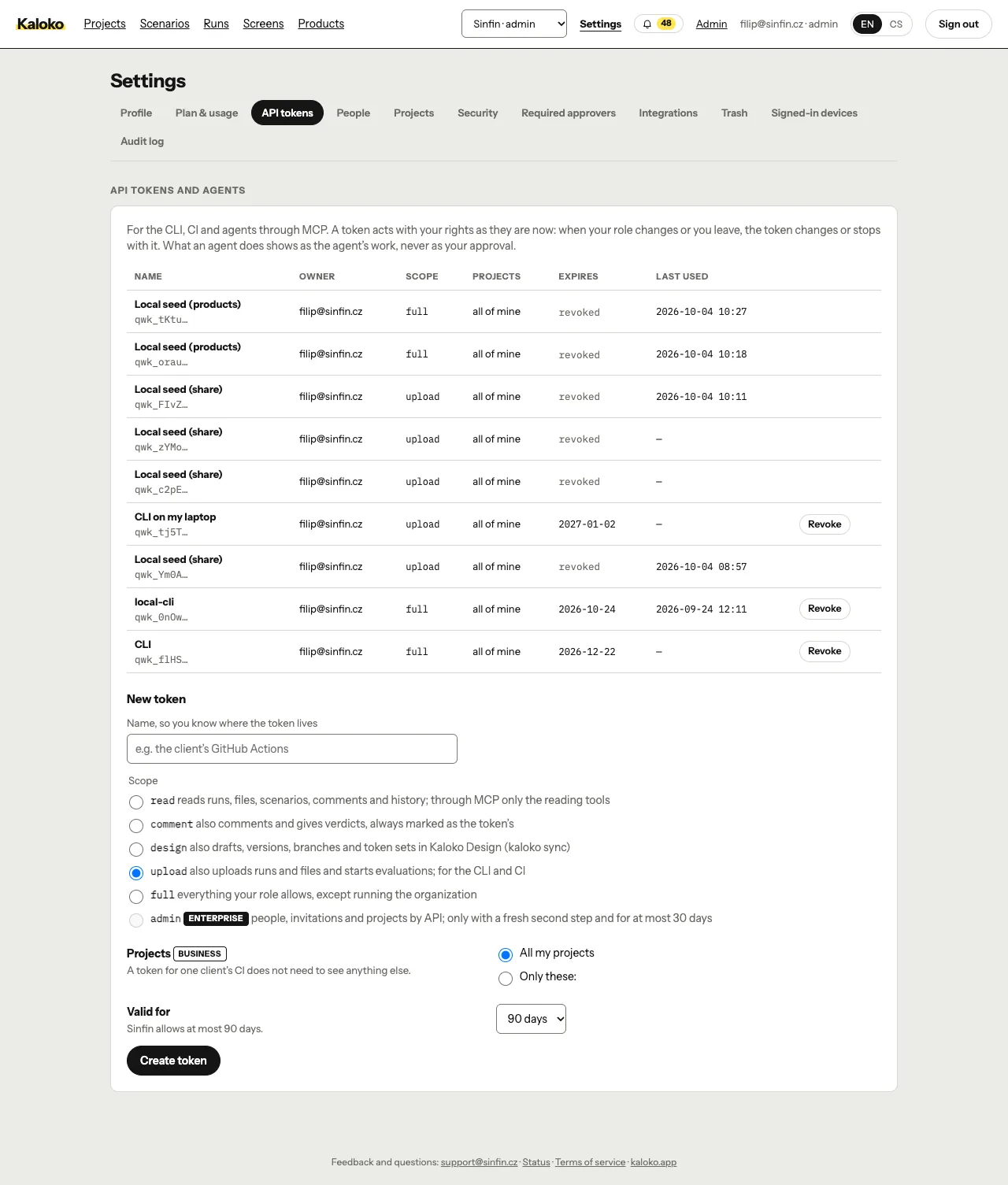
API tokens in Settings · - Name the token after where it lives, for example "laptop CLI" or "GitHub Actions".
- Tick what it may do. Reading is always included.
- comment and approve: comments and verdicts, as you
- design:
kaloko syncof design drafts - upload runs:
kaloko sharefrom the CLI or CI - everything my role allows
- Pick how long it lives: 30 days, 90 days or a year.
- Optionally limit it to chosen projects; it then sees only those and cannot create new ones.
- Copy the token once and put it into the project's
.envasKALOKO_TOKEN.
The list shows each token's owner, role, prefix, last use and expiry. Revoke ends a token at once.
Sign in from the terminal
On your own machine there is a shorter way:
npx kaloko loginThe browser opens; you approve the code, choose the organization and what the token may do. The page shows where the request came from, which terminal asked and when: approve it only if you just ran kaloko login yourself, and decline a link someone sent you. The token is valid for at most 30 days and is saved to ~/.config/kaloko/.env. --print prints it instead, --no-open shows the link without opening a browser.
Tokens for CI
Create a token with the upload runs scope, ideally limited to the project, and store it as a KALOKO_TOKEN secret in your CI. npx kaloko ci github and ci gitlab write workflows that read it; see the CLI reference.
Tokens for dashboards
A dashboard that pulls health once a week needs less than reading: pick read:health. Such a token reads the health of runs and the newest run of each scenario, and gets 403 for everything else, screenshots included. What it can call is in Health API for dashboards.
Rules an admin can set
Under Settings → Security an admin can allow only admins to create tokens with every right, turn off tokens limited to projects, and decide whether guests may create tokens at all. A guest's token sees only their projects. On Enterprise, service accounts hold tokens for automation that belongs to no person.